Nov 15, 2006

Dino Discovery


You and some friends were playing in a field near your house when you tripped over what you thought was a rock. After looking around, you find that there are other similar "rocks" around, but they are white. You realized that you have found fossils of a dinosaur! Not just any dinosaur, a Tyrannosaurus Rex.


Your task is to navigate through two websites to find more information on your recent dinosaur fossil discovery. You will need to take notes on what the T-Rex looks like and what habitat it can be found in. Your final outcome will be an illustration or re-creation of what the dinosaur looked like and what environment the T-Rex could be found, in addition to answering a few in-depth questions about the Tyrannosaurus Rex.

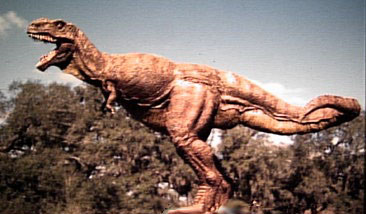
Tyrannosaurus Rex


At this first site, you will find information about what T-Rex's look like and their habitat.


1. Visit Tyrannosaurus Rex and Answer the below questions using the site’s information:
a) What does a T-Rex eat? What do these animals eat?
b) Where do T-Rex's live? and Why?
c) What do the feet of a T-Rex look like?
d) What is the tail like and why?
e) What animal is the T-Rex's skin like?
f) Where were the eyes located and why were they placed here?

2. Have fun learning interesting facts about the Tyrannosaurus Rex.

Fossil Findings


Here is a short video clip of a real archaeologist who recently discovered Tyrannosaurus Rex fossils in the United States.


1. Visit the Fossils site and click on the video play button to watch it.
2. Answer the following questions about information viewed in the video:
a) What discovery occured in 1990?
b) Where did they discover this?
c) What few aspects made this discovery so special?

3. You may replay or pause the video as many times as you need.

The project


With your new found information on the Tyrannosaurus Rex, you will create your very own illustration of a T-Rex in its most likely environment.


1. Before starting the illustration, you will need to answer a few questions about the Tyrannosaurus Rex:

a) Why did the Tyrannosaurus Rex have such a large, stiff tail?

b) Why did they live near forests and fertile water sources?

c)Why did the T-Rex's eyes face forward rather than to the sides of his body?

d)What known animal today resembles these certain body parts of the T-Rex? Feet: ;Height: ;skin: .

e)What species would you most relate a T-Rex to? a bird or a reptile and why?


2. For your illustration, you are to use features of living animals to re-create your own version of what a T-Rex would look like. i.e. the feet in your illustration would look like bird's feet.

3. The illustration of the T-Rex will include a body, head, feet, arms, tail and skin.

4. You are to set your T-Rex in the setting most fitting for its needs. Include images to show temperature, what the dinosaur eats, what landscape the T-Rex lives in, and anything else you would like to add.

5. You may relate to your notes for physical features of a T-Rex.

6. You can have fun exploring with different materials: feathers, leather, markers, sticks, colored pencils, crayons, stickers, etc.

7. Have fun creating your very own T-Rex!

Teacher support

  1. The intended audience is fourth graders.
  2. Students will learn information about the Tyrannosaurus Rex's physical features, habitat, what they ate, etc., why the T-Rex had certain features, where he got them, and what he used them for, they will learn how to apply abstract concepts like relating current day animals to that of a dinosaur, practice note taking skills, and work on creativity and imagination.
  3. Students will need to be able to read fluently, be familiar with the Internet and its functions, have some practice with abstract thinking, and background knowledge on features of current-day animals to begin this quest.
  4. Students will need 2 hours of computer time for this web quest assignment.
  5. In grading the projects and answers to questions, very good work would need to show an understanding of the physical features of the T-Rex, complete answers to questions with examples that seem plausible, and an illustration that demonstrates the student can recognize the aspects of a T-Rex related to modern-day animals and habitat that is in the forest, lush and eating meat/other animals. Work that is deemed OK would have a pretty good idea of what a Tyrannosaurus Rex looks like, answers to questions that are somewhat accurate (shows effort), and the illustration demonstrates physical aspects related to a T-Rex, but possible not the abstract ideas of other animals, and the habitat shows forests and sun but no animals. Work deemed not so good would show the student had no concept of a T-Rex's physical features, have answers not relating to the questions, and the illustration would show no effort in the illustration with little relevance to a T-Rex's habitat or physical features.